
Introduction
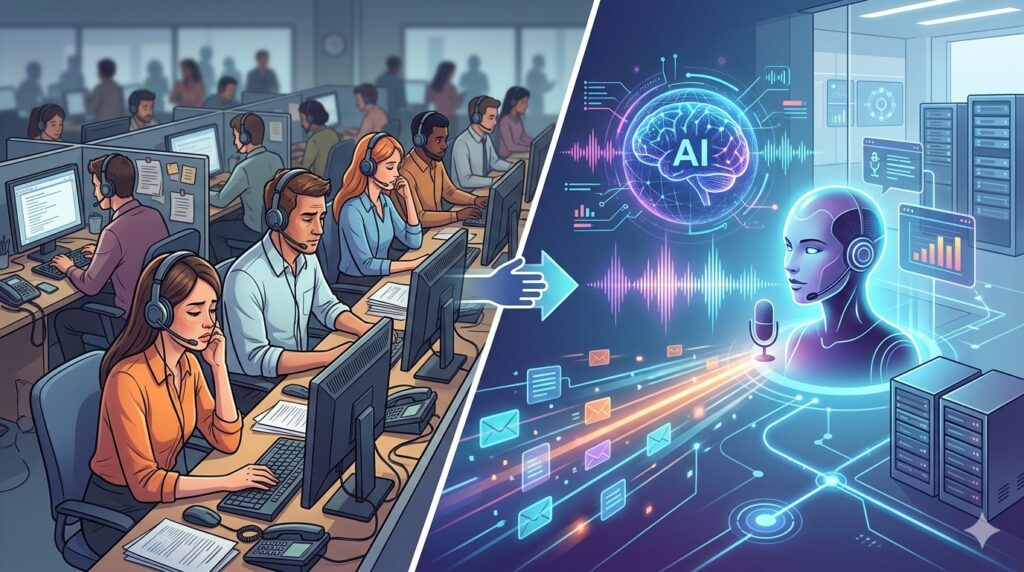
Customer support is changing fast. Not long ago, every business relied on large call centers filled with agents answering phones all day. Now things are shifting. AI voice agents are stepping in and doing a lot of that work faster, cheaper, and often better.
If you have ever called a business and spoken to a smooth, natural sounding assistant that handled your issue in seconds, there is a good chance you were talking to AI.
Let’s look at why this shift is happening and what it means for businesses.
What are AI voice agents
AI voice agents are systems that can talk to people over a phone call in a very natural way. They listen, understand what the caller means, and respond like a real person would.
They are built using speech recognition, language understanding, and voice generation. But you do not need to worry about the technical side. What matters is this
They can hold real conversations.
They can answer questions.
They can complete tasks like booking appointments or checking order status.
And they can do all of this without getting tired.
Why traditional call centers are struggling
Call centers have worked for years, but they come with real problems.
First is cost. Hiring, training, and managing a team is expensive. If you want support all day and night, the cost goes even higher.
Second is waiting time. Most people hate being put on hold. Even a few minutes feels too long when you need help.
Third is inconsistency. Different agents give different answers. Some are great, some are not. That affects customer trust.
And finally, scaling is hard. If your business suddenly gets more calls, you cannot instantly hire and train new people.
How AI voice agents are taking over
Always available
AI does not sleep. It can answer calls at any time of the day. Your customers can get help whenever they need it.
No waiting time
AI can handle many calls at the same time. That means no queues, no frustration, and no lost customers.
Lower costs
This is one of the biggest reasons businesses are switching. AI can handle a large volume of calls at a fraction of the cost of a full team.
Consistent answers
AI gives the same accurate response every time. It follows your business rules and does not get confused or emotional.
Faster service
AI responds instantly. Customers get answers in seconds instead of waiting.
Real world examples
In online stores, AI helps customers track orders or request returns.
In clinics, it books appointments and sends reminders.
In real estate, it answers property questions and filters serious buyers.
In sales, it follows up with leads and even makes initial calls.
These are not future ideas. Businesses are already doing this today.
Are call centers going away completely
Not really.
Humans are still important, especially when a situation is complex or emotional. What is happening is a shift.
AI handles the repetitive and simple tasks.
Humans focus on the conversations that need empathy and deeper thinking.
This balance actually makes the whole system better.
What this means for businesses
If you run a business, this change is an opportunity.
You can reduce your costs.
You can respond to customers faster.
You can handle more leads without hiring more people.
And you can give a smoother experience to everyone who contacts you.
Businesses that adopt this early are already seeing strong results.
The future of voice AI
Voice AI is only getting better. It is becoming more natural, more human, and more aware of how people feel during conversations.
In the near future, it will be hard to tell whether you are speaking to a human or AI.
And for most everyday support needs, people will not even mind.
Conclusion
AI voice agents are not just another tech trend. They are changing how businesses talk to their customers.
Call centers are not disappearing overnight, but their role is getting smaller as AI takes over routine work.
If you are thinking about improving your customer support or scaling your business, this is something worth paying attention to.
The shift is already happening. The question is whether you want to be early or late.